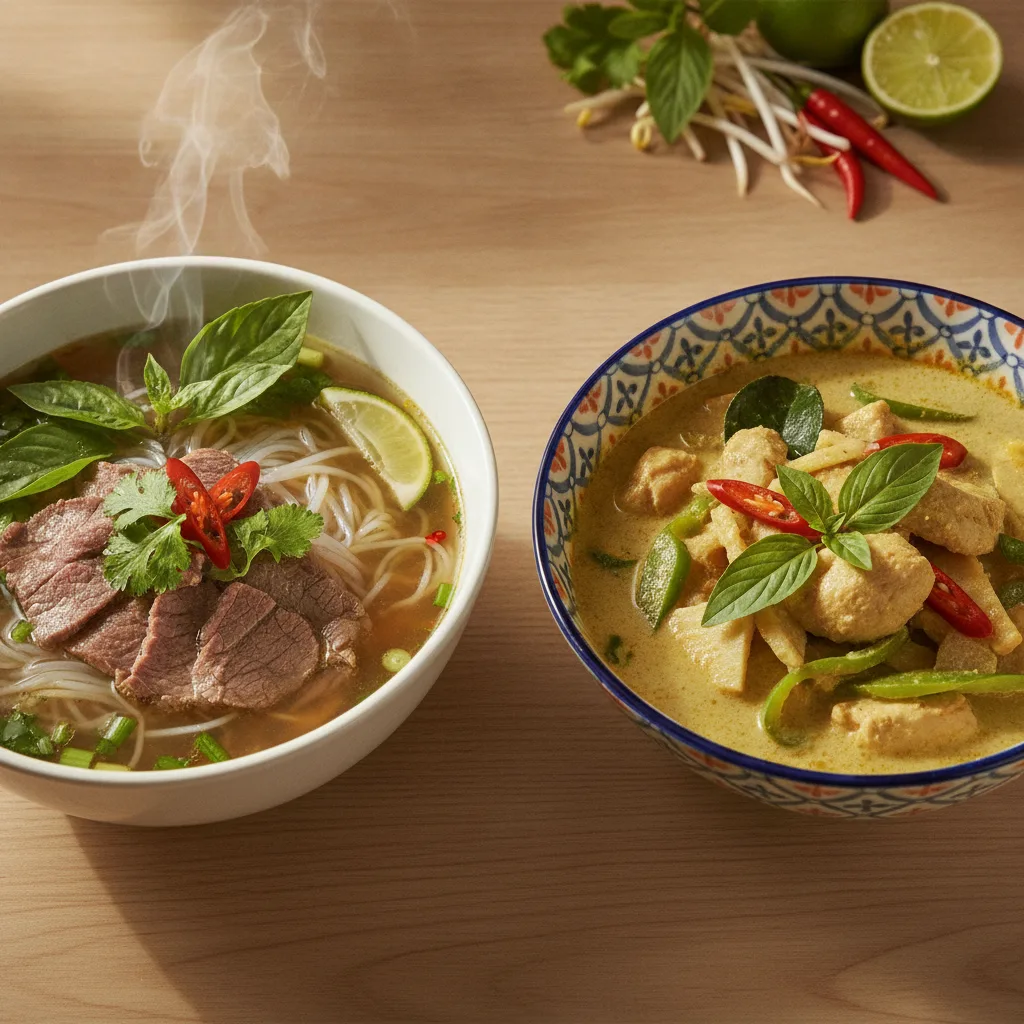
Fragrant pho on one side, green curry with coconut milk on the other: two neighbouring cuisines, often confused in Europe, yet based on very different principles. The difference between Vietnamese and Thai cuisine lies not only in the level of chilli heat, but also in the use of fresh herbs, the role of the stock, the way dishes are seasoned and even the way they are served.
At Mây Bay, a 100 % vegetarian and vegan Vietnamese restaurant in Vincennes, we regularly explain these distinctions to our customers. Here are seven clear distinctions that will help you choose where to dine next.
The difference between Vietnamese and Thai cuisine – 7 key points
Reading time: ~10 mins
- Two neighbouring countries in South-East Asia, a shared foundation
- 1. The flavour profile: herbaceous clarity versus concentrated intensity
- 2. Signature ingredients: nuoc-mâm versus curry paste
- 3. Chilli isn’t the dividing line we think it is
- 4. Cooking techniques: stock versus mortar
- 5. Phở and pad thai: two opposing approaches
- 6. Regional variations are a game-changer
- 7. Which is the lightest, and how do you choose?
- The Vietnamese traditional approach to plant interpretation at Mây Bay
- Exploring the differences between Vietnamese and Thai cuisine in greater depth
- Frequently Asked Questions
Two neighbouring countries in South-East Asia, a shared foundation
Vietnam and Thailand share a similar climate, markets and a history of trade, which explains their similarities. Rice, rice noodles, lemongrass, lime, chilli, coriander, crunchy vegetables and fermented sauces can be found on both sides of the border. Both culinary traditions also seek a balance between salty, sweet, sour, bitter and spicy flavours – a principle often summarised as the ‘balance of the five flavours’.
It is precisely this similarity in ingredients that confuses people in the West, even though the final flavour profiles bear little resemblance to one another.
The real question, therefore, is not which is the most authentic, but how each brings these elements together. Vietnamese cuisine tends towards clarity, freshness and the layering of textures. Thai cuisine tends towards concentration, contrast and aromatic intensity, carefully crafted in advance by the chef.
1. The flavour profile: herbaceous clarity versus concentrated intensity
Vietnamese cuisine: freshness that’s evident on the palate
Vietnamese cuisine is characterised by its signature fresh, herbaceous flavour. The tartness of lime, the salty and umami notes of nuoc-mâm, a touch of sugar and a profusion of Vietnamese mint, coriander and Thai basil come together to create a light, well-balanced dish in which each ingredient remains distinct.
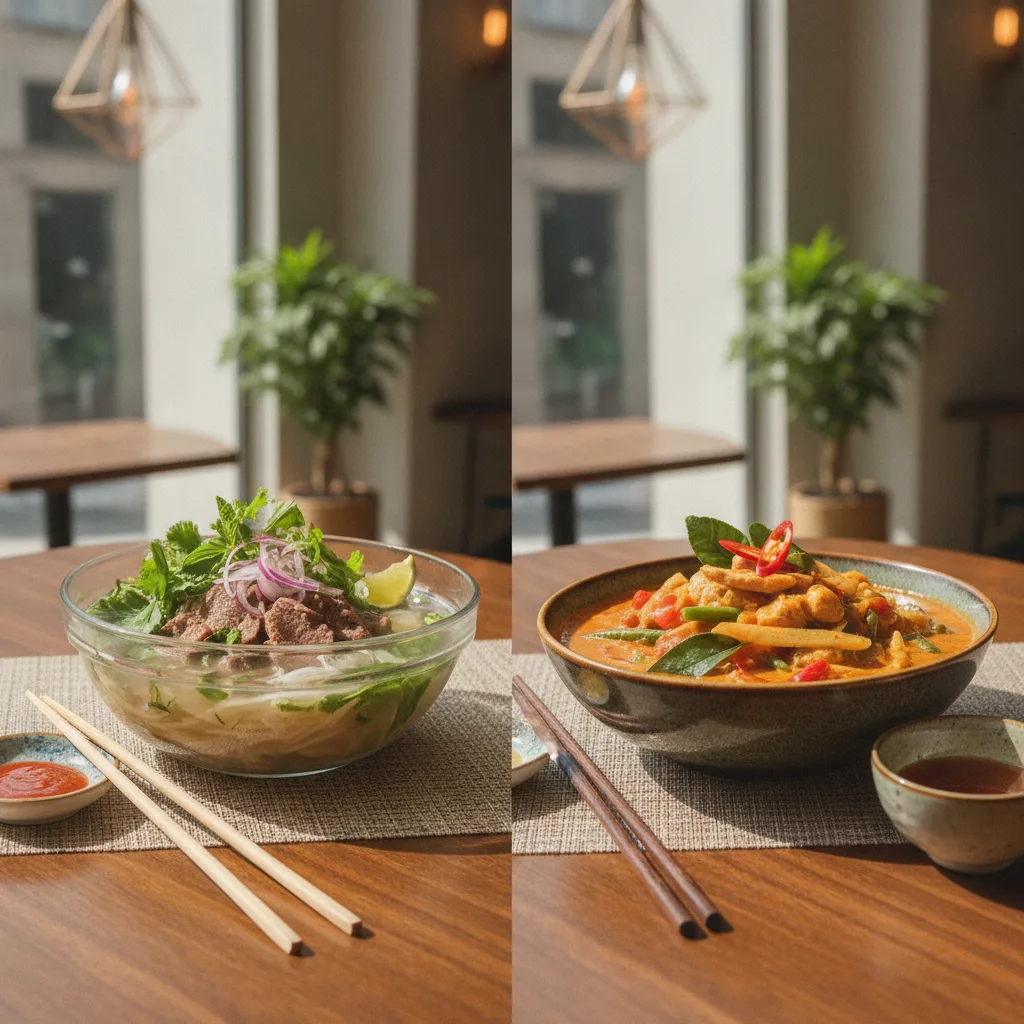
The works published by Education About Asia point out that Vietnamese cuisine places as much emphasis on flavours as on textures – crunchy, soft, crispy or melt-in-the-mouth – all on the same plate.
Thai cuisine: concentrated aromatic intensity
Thai cuisine, on the other hand, is all about making an impact. The’Tourism Authority of Thailand describes a balance of bold flavours, achieved through chilli, tamarind, palm sugar, fish sauce and lime. The flavours blend together right from the start of the preparation, so that the very first bite already conveys the full flavour profile.
Whereas a Vietnamese dish comes together on the palate, a Thai dish is often presented fully assembled on the plate.
2. Signature ingredients: nuoc-mâm versus curry paste
Iconic ingredients of Vietnamese cuisine
The ingredients used in Vietnamese and Thai cuisine share a common foundation, but diverge markedly in terms of their defining characteristics. On the Vietnamese side, nuoc mâm – a fermented fish sauce – forms the basis of the seasoning, accompanied by rice vinegar, ginger, Saigon cinnamon, rice crackers and a bouquet of herbs served on the side.
Research published in Asianetwork Exchange highlights this widespread consumption of fresh herbs and the central role played by accompanying sauces.
Iconic ingredients of Thai cuisine
On the Thai side, the key ingredients are galangal, kaffir lime leaves, prawn paste, palm sugar, tamarind, coriander root and, above all, green, red or yellow curry pastes. Coconut milk is used in many curries and desserts, though not in every dish.
Nuoc-mâm, or more accurately fish sauce, also exists in Thailand under the name nam pla, but there it is just one seasoning amongst many, whereas in Vietnam it plays an almost fundamental role.
| Criterion | Vietnamese cuisine | Thai cuisine |
|---|---|---|
| Dominant profile | Fresh, grassy, light, umami | Intense, spicy, sweet and sour, fragrant |
| Markers | Nuoc-mâm, Vietnamese mint, coriander, Thai basil, rice noodles | Curry paste, coconut milk, galangal, kaffir lime leaves, tamarind |
| Chilli | Often served separately, with the guest deciding the portion | Often used in pasta and sauces |
| Fat content | Limited to broths and fresh dishes | Coconut milk and the most common types of curry paste |
| Key techniques | Slow-cooked stock, steamed dishes, grilled dishes, cold platters | Pounding in a mortar, stir-frying in a wok, simmering in coconut milk |
| Signature dishes | Phở, bún, bánh mì, spring rolls, bún chả | Pad Thai, tom yum, green curry, som tam |
| Service | Herbs and condiments served on the side | Seasoning added to the mixture |
3. Chilli isn’t the dividing line we think it is
To say that Vietnamese cuisine isn’t spicy is inaccurate. The centre of the country, centred around Huế and its imperial tradition, produces dishes that are decidedly spicy, complex and sometimes more potent than many Thai recipes. The difference lies in the flexibility: in Vietnam, fresh chillies, limes and sauces are often brought to the table, and everyone adjusts their own dish to taste. So, whilst spicy Vietnamese cuisine does exist, it is a matter of personal preference.
In Thailand, chilli is more commonly added during the cooking process, either to a Thai curry paste or to a salad such as som tam. The Thailand Foundation He emphasises this point: the herbs are crushed to release their oils and form a concentrated base, which makes it difficult to adjust the level of chilli afterwards. It is a culinary choice, not a question of greater intensity.
Good to know
In a Vietnamese restaurant, asking for the sauce on the side is still the best way to adjust the heat without spoiling the dish, which is rarely possible with a curry that has already been simmered.
4. Cooking techniques: stock versus mortar
Typical cooking techniques in Vietnam
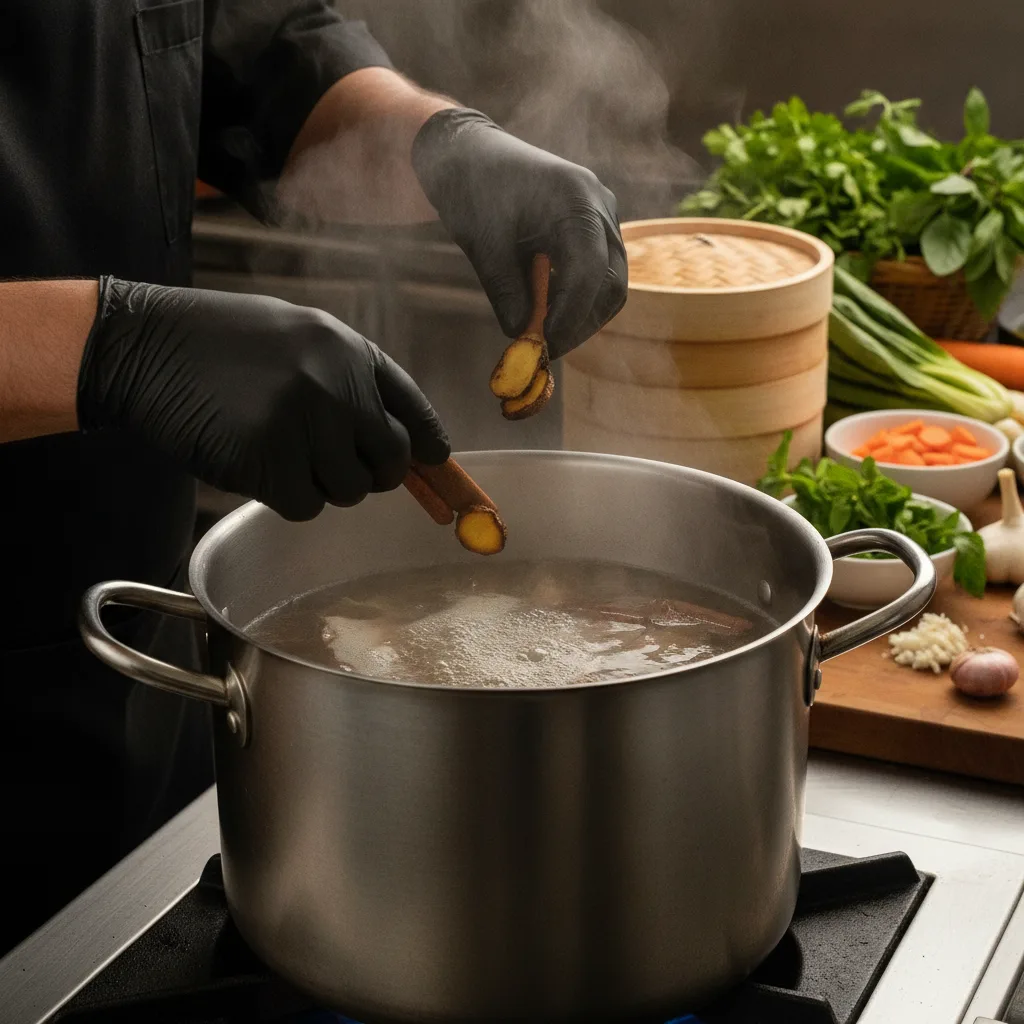
Cooking techniques distinguish the two cuisines even more clearly than spices. The defining feature of Vietnamese cuisine is the stock, simmered for hours, clarified and flavoured with whole spices, Saigon cinnamon, roasted ginger and aromatic herbs. This stock forms the centrepiece around which steaming, grilling, light frying, fermentation and the cold assembly of herbs, vegetables and rice noodles revolve, as in spring rolls wrapped in rice paper.
Typical cooking techniques in Thailand
The fundamental step in Thai cooking is pounding ingredients in a mortar. Garlic, shallots, galangal, lemongrass, kaffir lime leaves and chillies are pounded to form a paste, which is then fried in fat and thinned with coconut milk or stock. Other key techniques include stir-frying in a wok over a high heat, quick stir-fries and pounded salads.
A Thai dish is often put together in a matter of minutes, using a base prepared in advance, whereas a Vietnamese dish relies on slow cooking carried out the day before.
5. Phở and pad thai: two opposing approaches
The difference between phở and pad thai sums up almost everything. Phở is a rice noodle soup served in a clear broth, simmered for a long time and barely seasoned on the surface, which you top up yourself with fresh herbs, bean sprouts, lime and chilli. Pad Thai is a dish of noodles stir-fried in a wok, seasoned with tamarind, palm sugar and fish sauce, and topped with crushed peanuts – so it’s sweet, tangy and already fully prepared.
The comparison between phở and tom yum follows the same logic. Tom yum is a tangy, spicy soup, characterised by lemongrass, galangal and kaffir lime leaves, the intensity of which is immediately striking. Phở, on the other hand, is savoured in layers, with a deliberately subtle broth that allows the herbs to shine through.
One final useful point: neither phở nor pad thai fully represent their respective cuisines, which include dozens of popular Vietnamese and Thai dishes that are far less widely known abroad, from bún chả to bánh mì, and from the cuisine of Isan in north-eastern Thailand to the curries of the south.
6. Regional variations are a game-changer
To speak of Vietnamese cuisine in the singular is an oversimplification. The north favours subtle flavours and lightly sweetened broths; the centre embraces spicy dishes inherited from the imperial court of Huế; whilst the south emphasises mild flavours, tropical fruits and, at times, coconut milk.
Thailand offers the same diversity, ranging from the curries and rice dishes of the centre, the influences of the north, the very spicy salads and sticky rice of Isan cuisine, to the rich, seafood-based curries of the south.
These regional culinary variations explain why generalisations quickly fall flat. Coconut milk, for example, is common in Thailand but absent from many salads, soups and grilled dishes, whilst it features in certain southern Vietnamese desserts, such as the bananas with tapioca pearls and coconut milk that we serve in Vincennes.
7. Which is the lightest, and how do you choose?
Neither cuisine is inherently healthier. It all depends on the recipe, the portion size, and the amount of sugar, salt and fat. Vietnamese broths, herbs and raw vegetables often make for relatively light dishes, whilst curries made with coconut milk are higher in calories. Conversely, a Thai pounded salad is very light, whereas spring rolls are not. Fermented sauces and curry pastes also provide sodium in both cuisines.
Practical tips for choosing between the two kitchens
When deciding between a Vietnamese or a Thai restaurant, a few simple pointers are all you need, depending on what you’re in the mood for that day.
- If you like broths, fresh herbs and light, fresh Asian cuisine that you can tailor to your own taste: Vietnam.
- If you’re looking for creamy, fragrant and seriously spicy ready-to-use sauces, look no further than Thailand.
- You’re having lunch in 45 minutes between two appointments and want something light to eat: a bún or a Vietnamese soup.
- You want to share several distinctive dishes in the centre of the table: Thai curries and salads.
Key points
The main difference between Vietnamese and Thai cuisine lies in when the seasoning is added: at the table in Vietnam, and whilst cooking in Thailand.
The Vietnamese traditional approach to plant interpretation at Mây Bay
In Vincennes, we have chosen to specialise exclusively in vegetarian and vegan cuisine, without compromising on authentic Vietnamese flavours. The slow-simmered stock remains the backbone of our dishes, made from vegetables, shiitake mushrooms and whole spices, with the same emphasis on clarity and umami. Fresh herbs are served on the side, as is customary, and the accompanying sauce is available in a plant-based version to replicate the role of nuoc mâm without any animal products.
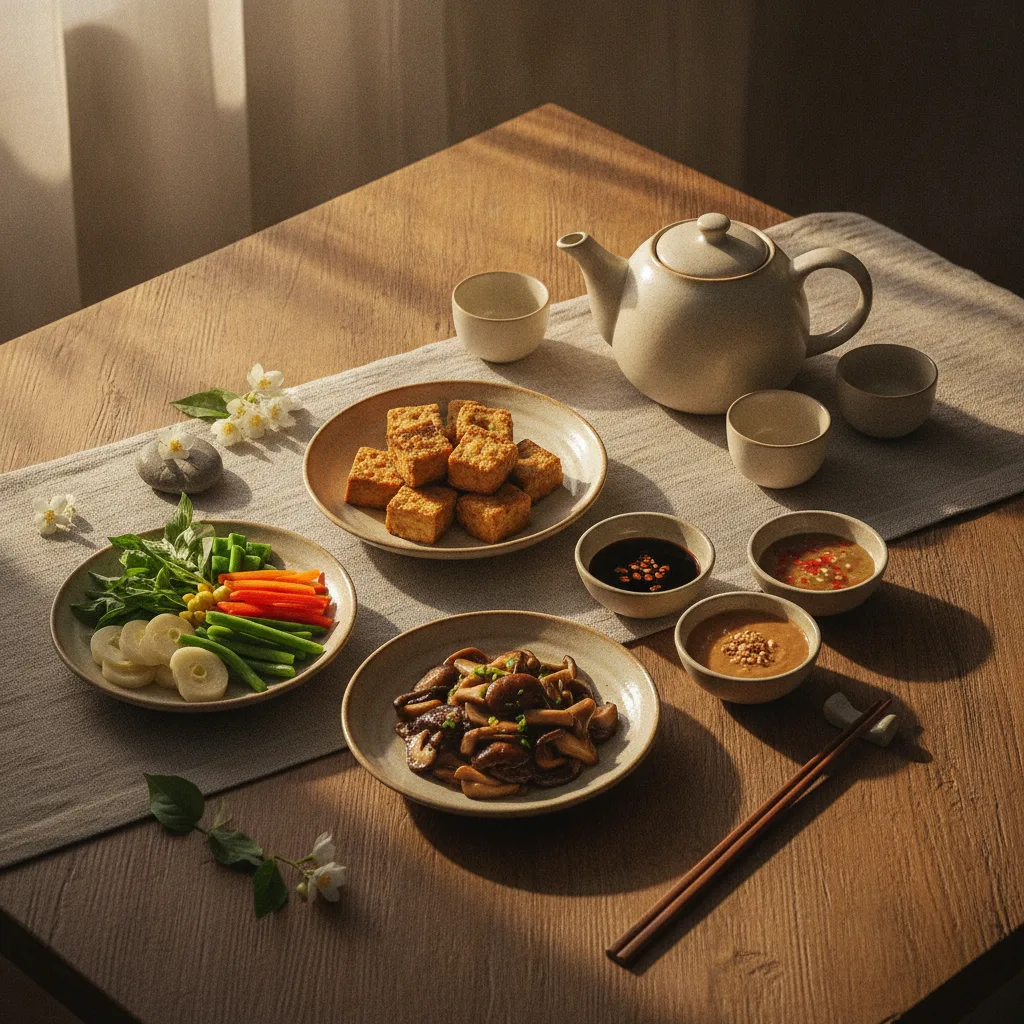
Our concept is based on combining a venue where you can sample fresh, healthy dishes with a contemporary, relaxing setting. Here you’ll find the bún chả giò, our plant-based version of vermicelli with spring rolls, the bánh cuốn, steamed rice pancakes, the Bà Dung’s stew, a Vietnamese-style curry served with plain rice, or even Mây Bay’s hủ tiếu.
The The full map is available online, and a A takeaway option is available for those in a hurry at lunchtime.
Exploring the differences between Vietnamese and Thai cuisine in greater depth
Comparing Vietnamese and Thai cuisine solely on the basis of chilli is to miss the point entirely. Vietnam relies on slow-simmered broths, fresh herbs and seasoning left to the diner’s discretion. Thailand concentrates its flavours in a pounded paste, a sizzling wok or a coconut milk sauce. Two methods, two delights, no hierarchy.
If the first approach appeals to you, a A table in Vincennes awaits you to assess the matter on the evidence in 2026.
FAQ
Is it possible to eat a completely vegetarian meal in a Vietnamese restaurant?
Yes, the Vietnamese Buddhist tradition has a long history of animal-free cuisine, known as chay cuisine. It replaces fish sauce with fermented vegetable preparations and features tofu, mushrooms and seasonal vegetables.
Which drink goes best with a Vietnamese meal?
Green tea and flavoured infusions – such as lemongrass, chrysanthemum or ginger – cleanse the palate between mouthfuls. At the end of a meal, Vietnamese filter coffee, served hot or iced, remains the local speciality.
Which herbs should you buy to cook Vietnamese food at home?
Vietnamese mint, coriander, Asian basil, spring onions and perilla form the most versatile base. They are served raw, arranged in a bouquet on the table, and not cooked, which preserves their aromatic profile.
Why does Vietnamese broth simmer for so long?
Slow cooking draws out the flavours from whole spices and vegetables whilst keeping the liquid clear. If the stock is allowed to boil too vigorously, it becomes cloudy and loses the delicacy sought after in both phở and hủ tiếu.
Is Vietnamese cuisine suitable for a quick business lunch?
Yes, the bowl dishes, served as a set, are served quickly and are light and easy to eat, meaning you can have lunch in about an hour, whether you eat in or order a takeaway.