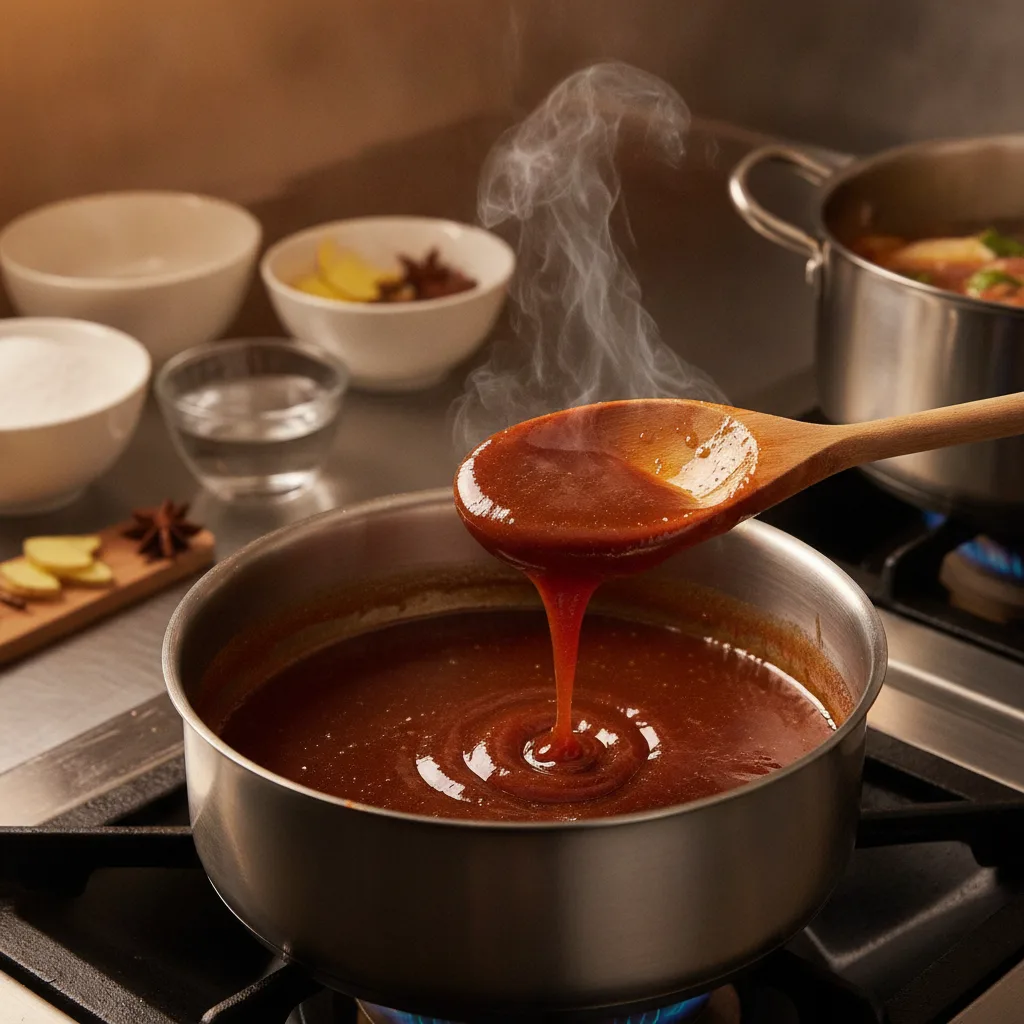
Vegan Vietnamese caramel is as intriguing as it is reassuring. It is nước màu, the mahogany-brown syrup that gives Vietnamese stews their deep colour and slight bitterness. In its traditional version, it contains only sugar and water, making it naturally compatible with a 100 % plant-based cuisine.
At Mây Bay, a vegetarian and vegan Vietnamese restaurant in Vincennes, we work with this technique every day, from savoury dishes to desserts. Here’s how to understand it, get it right at home and find it in our cuisine.
Vegan Vietnamese caramel, homemade nước màu recipe
Reading time: ~10 mins
- What is nước màu, this vegan Vietnamese caramel?
- Is Vietnamese caramel really vegan?
- Nước màu or coconut milk caramel: two preparations not to be confused
- Which sugar should you choose for successful vegan Vietnamese caramel?
- How to make homemade nước màu, step by step
- Common mistakes and how to fix them
- Replacing fish sauce in a vegan Vietnamese sauce
- Which plant-based dishes can you use Vietnamese caramel with?
- Storage of homemade nước màu
- Vegan Vietnamese caramel in Mây Bay’s cuisine
- Frequently asked questions about vegan Vietnamese caramel
- Going further with vegan Vietnamese caramel
What is nước màu, this vegan Vietnamese caramel?
Nước màu, sometimes called nước hàng in northern Vietnam, is a concentrated caramel syrup obtained by slowly caramelising sugar. It is nothing like Western pastry caramel.
Its primary role is to give slow-cooked dishes a mahogany-brown colour, controlled caramel bitterness and aromatic depth that rounds out savoury flavours. In southern Vietnamese cuisine, it serves as a natural flavour enhancer in kho dishes, preparations braised for a long time in a short, glossy sauce.
The basic recipe is disarmingly simple, as it relies on just two ingredients: sugar and water. This simplicity explains its popularity in Asian vegan cuisines, since no animal products are involved in the traditional preparation. The entire process depends on controlling the temperature and colour, and stopping the cooking at exactly the right moment.
Is Vietnamese caramel really vegan?
In its most classic form, yes. A syrup made solely from granulated white sugar and water is compatible with a vegan diet. The problem arises with certain regional or family variations that incorporate fish sauce to achieve a more complex salty Vietnamese caramel. This version, often called fish sauce caramel, is not vegan and should be ruled out whenever you are aiming for a nước màu without fish sauce.
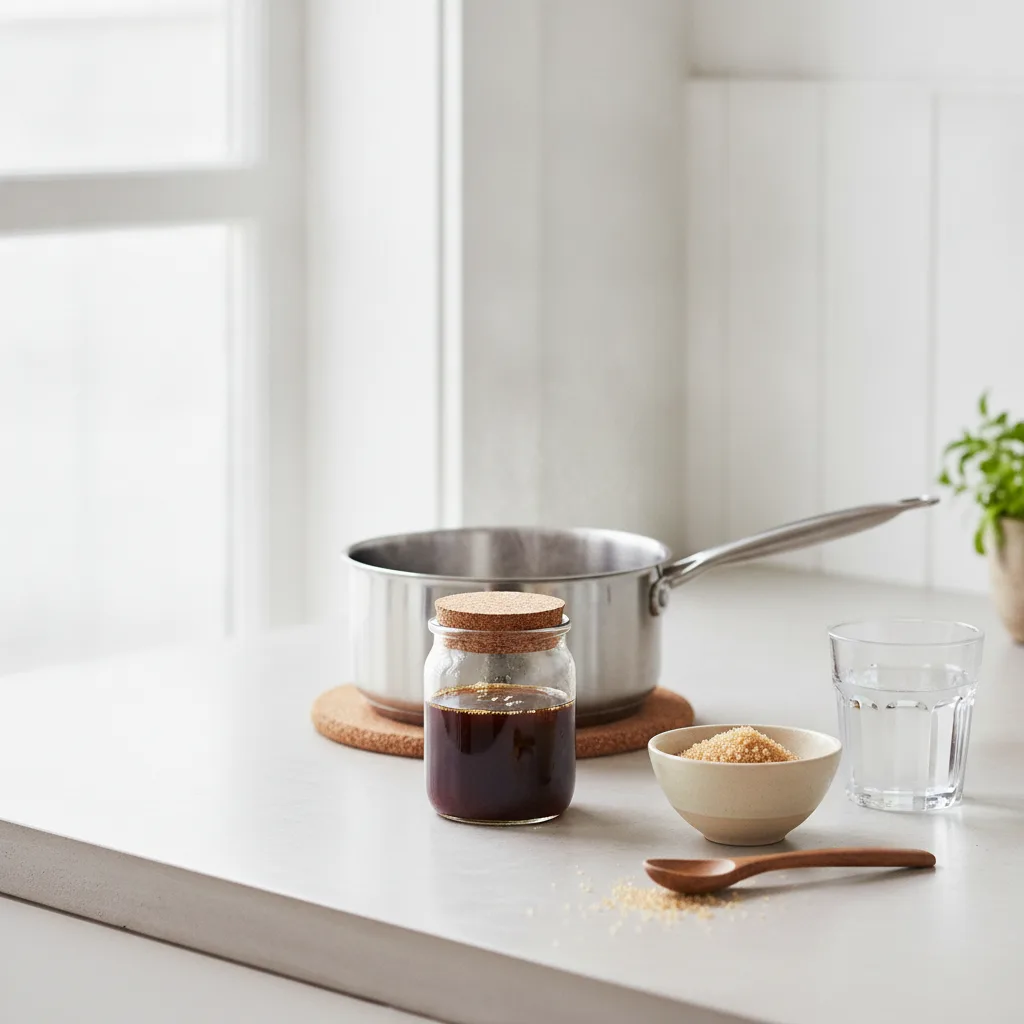
A few other ingredients should be watched for if you buy a ready-made product rather than making your easy homemade Vietnamese caramel. Butter, cream, condensed milk and honey immediately disqualify a vegan Vietnamese caramel sauce. Some refined sugars may also be questionable depending on their filtration process, hence the importance of checking for a vegan label or choosing an unrefined sugar whose origin is clearly stated.
Nước màu or coconut milk caramel: two preparations not to be confused
The confusion is common. Nước màu is a salty, bitter, very dark syrup intended for cooking. Vietnamese coconut milk caramel, on the other hand, belongs to the sweet category. Coconut milk or a plant-based cream is added to create a smooth, mild sauce that coats bananas, tapioca or a rice cake. The two share the same technical foundation, the caramelisation of sugar, but not the same role in a meal.
This distinction structures our menu. The savoury category draws on the depth of nước màu, while the sweet category relies on the roundness of coconut milk, as in our che chuoi, bananas with tapioca pearls, coconut milk and peanuts.
Which sugar should you choose for successful vegan Vietnamese caramel?
Granulated white sugar remains the standard choice for beginners. Neutral in flavour, it allows you to follow the colour's progression very precisely, from transparent to pale yellow, then amber and finally deep reddish brown. Brown sugar, soft brown sugar or palm sugar produce a more distinctive Vietnamese palm sugar caramel, with notes of molasses and dried fruit, but they partially mask changes in colour and make visual assessment more difficult. For a first attempt, it is better to start simply and then explore unrefined sugars.
Good to know
A few drops of lemon juice added at the beginning of cooking limit sugar crystallisation and make the result more reliable, especially if your saucepan is not perfectly clean.
How to make homemade nước màu, step by step
Before you begin, gather a heavy-based saucepan, hot water already prepared in a kettle and a clean glass jar. Preparation takes less than fifteen minutes but allows no distractions, as the colour develops very quickly at the end of cooking.
The ingredients for approximately 150 ml of syrup are as follows:
- 100 to 160 g granulated white sugar, or grated palm sugar for a more aromatic version
- 60 ml cold water to moisten the sugar initially
- 120 ml hot water to loosen the caramel at the end of cooking
- a few drops of lemon juice, optional
- Pour the sugar and 60 ml of water into the saucepan, then heat over medium-low heat until completely dissolved.
- As soon as it starts boiling, stop stirring and simply gently swirl the saucepan to even out the colour.
- Monitor the colour continuously: the syrup turns yellow, then amber, then very dark brown, close to black coffee or molasses.
- Remove from the heat immediately at this stage, as the difference between a good caramel and burnt caramel is a matter of seconds.
- Then add the hot water very slowly, keeping your distance and preferably wearing long sleeves.
- Return the saucepan to low heat and stir until the solidified pieces have completely dissolved.
- Allow to cool before transferring to an airtight container.
Contact between hot water and very hot caramel causes a vigorous reaction, with splashes and steam release.
Important
Never add cold water to very hot caramel. The thermal shock instantly sets the sugar into hard lumps and increases the risk of hot splashes.
Common mistakes and how to fix them
Caramel that is too pale, too dark or hardens
Caramel that is too pale lacks colouring power and character. Simply continue cooking for a few moments, keeping an eye on the saucepan. Conversely, caramel that has turned black with an acrid smell cannot be salvaged; the bitterness overwhelms the whole dish and it is best to start again in a clean saucepan.
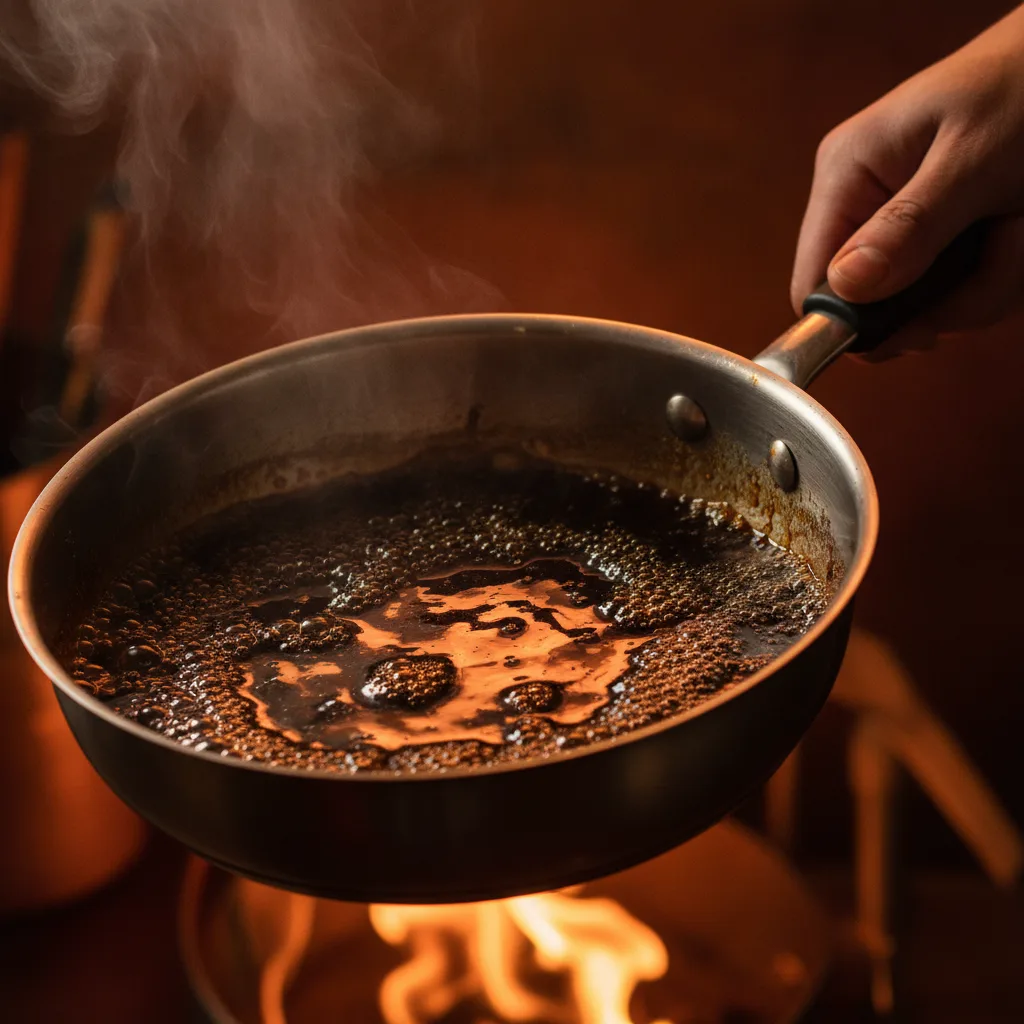
If the caramel hardens on contact with water, this is perfectly normal; it will dissolve when gently reheated while stirring. As for sugar crystallisation, this can be prevented by using an impeccable utensil, avoiding any stirring after boiling begins and optionally adding that famous dash of lemon juice.
Replacing fish sauce in a vegan Vietnamese sauce
Creating a plant-based alternative to fish sauce
This is the heart of the adaptation process. Fish sauce provides salt, umami and a fermented note. To obtain a convincing plant-based equivalent, we combine a nước màu base with soy sauce or gluten-free tamari, a little fermented plant-based sauce, rehydrated dried mushrooms and concentrated vegetable stock.
The Vietnamese aromatics do the rest: crushed lemongrass, fresh ginger, garlic, chilli and a touch of lime juice to liven everything up. The result does not imitate fish sauce; it offers a different, more plant-based depth, but one that is equally well structured.
What vegetable dishes to use Vietnamese caramel with for tofu and vegetables
Ideas for vegan dishes with Vietnamese caramel
Vegan nước màu is used wherever a Vietnamese braised dish calls for colour and depth. Tofu kho, inspired by tofu kho tàu, is its most iconic use, with firm tofu caramelised in a short, glossy sauce. Braised shiitake mushrooms, braised aubergines, roasted squash or simple plain rice all work very well with it. It is also used in vegetable marinades, sweet-and-sour sauces or to adjust the colour of a stock.
Here is a comparison of the main variants found in Vietnamese cuisine.
| Variant | Vegan | Main use | Particular features |
|---|---|---|---|
| White sugar and water | Yes | Savoury braised dishes | Neutral flavour, easy-to-control colour |
| Brown sugar or soft brown sugar | Yes | Savoury dishes and sauces | Deeper notes, pronounced caramelisation |
| Palm sugar | Yes, depending on the product | Southeast Asian cuisine | Distinctive aromatic profile, more opaque colour |
| Caramel and soy sauce | Yes | Tofu, vegetables, mushrooms | Plant-based alternative to fish sauce |
| Caramel and fish sauce | No | Traditional non-vegan recipes | To exclude from a vegan menu |
| Caramel and coconut milk | Yes | Desserts and sweet sauces | Creamy texture, sweet profile |
Storage of homemade nước màu
Once cooled, the syrup is transferred to a clean glass jar and sealed tightly. Caramel made solely from sugar and water keeps well thanks to its high sugar concentration, and some traditional recipes store it at room temperature.
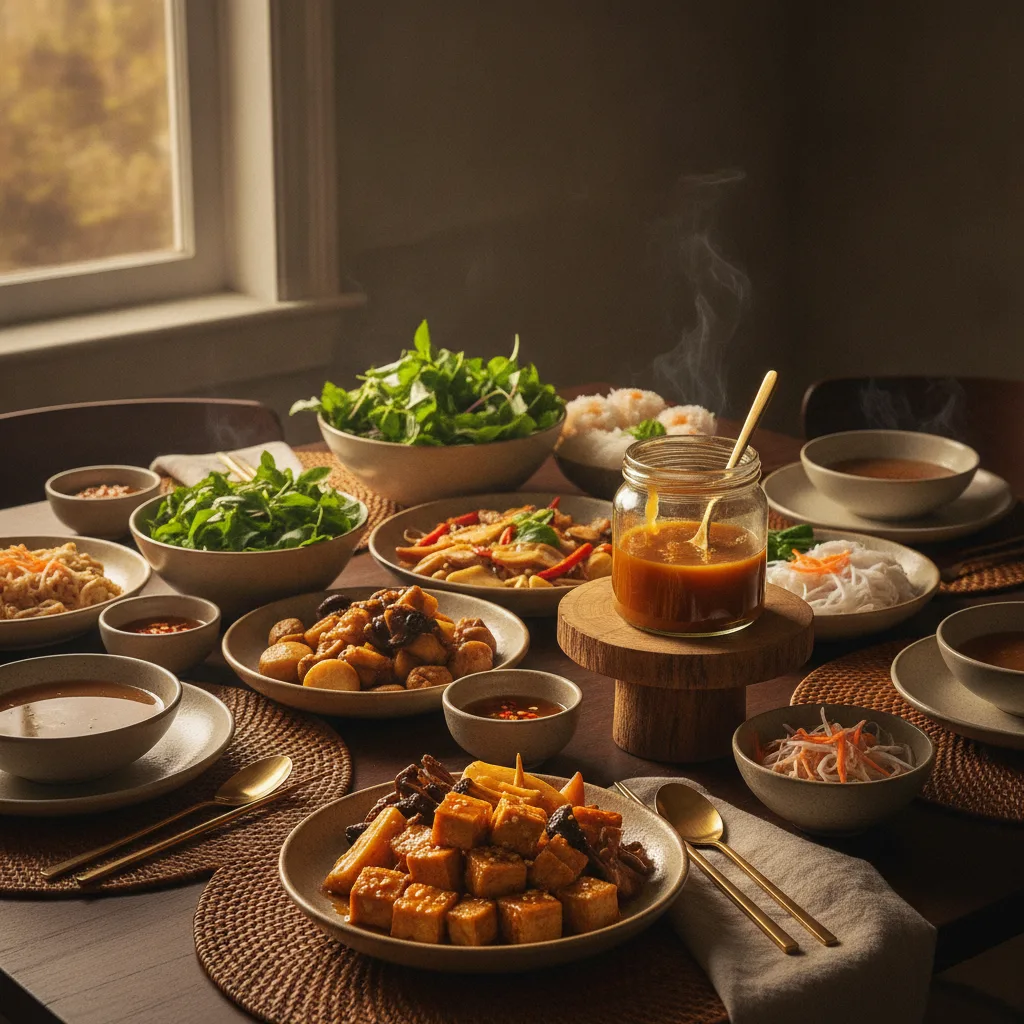
As soon as you add extra water, fresh flavourings or other plant-based ingredients, refrigeration becomes essential. Label the production date, never put a wet or dirty utensil into the jar, and check the smell, appearance and texture before each use. In catering, these practices form part of an HACCP-style food safety management plan, with batch traceability and temperature monitoring.
Vegan Vietnamese caramel in Mây Bay’s cuisine
Our concept is based on combining a place to enjoy fresh, healthy dishes with a contemporary setting for relaxation, in the heart of Vincennes. Caramel-making plays a discreet but decisive role here, in both plant-based stews and desserts.
Our sweet treats continue this approach, with banh bao chi with coconut pearls, banh bo, a puffed rice cake, and our iced Vietnamese coffee with coconut milk flavoured with pandan, available in our dessert menu.
If you would like to discover this cuisine without preparing it yourself, our menu can be viewed on our menu and bookings can be made via our page Contact and bookings. For a quick lunch or an evening takeaway meal, the takeaway option is detailed on our page to take away.
FAQ – frequently asked questions about vegan Vietnamese caramel
Can nước màu be prepared without any water at the start?
Yes, this is the so-called dry method, where the sugar melts on its own in the saucepan. It is quicker but much less forgiving, as the colour becomes very difficult for a beginner to stabilise.
Does Vietnamese caramel contain gluten?
The basic syrup, made from sugar and water, does not. However, a finished sauce combining caramel with regular soy sauce may contain gluten, hence the benefit of using tamari for a gluten-free version.
How much nước màu should be used in a dish?
One to two tablespoons are generally enough for four servings. The syrup is concentrated; too much will make the dish bitter and too dark.
Can Vietnamese caramel made at home be frozen?
It is not necessary. The high sugar content already ensures good stability, and freezing alters the texture of the syrup when thawed.
Is there a difference in taste between nước màu and nước hàng?
Both refer to the same preparation, with regional variations in quantities and cooking. The term nước hàng is more common in northern Vietnam, while nước màu is used in the south.
Can you give someone a taste of this cuisine as a gift?
Yes, we offer gift vouchers for our menus.
Going further with vegan Vietnamese caramel
Vegan Vietnamese caramel perfectly illustrates what makes Vietnamese cuisine so adaptable to plant-based cooking: a simple technique, two ingredients, and complete attention to the cooking process. Mastering nước màu gives you access to a whole family of stews, marinades and desserts without ever using an animal product.
Whether you prepare it at home or come and taste it in our dishes in Vincennes, what matters most is getting the colour just right and achieving the balance between sweetness and bitterness.