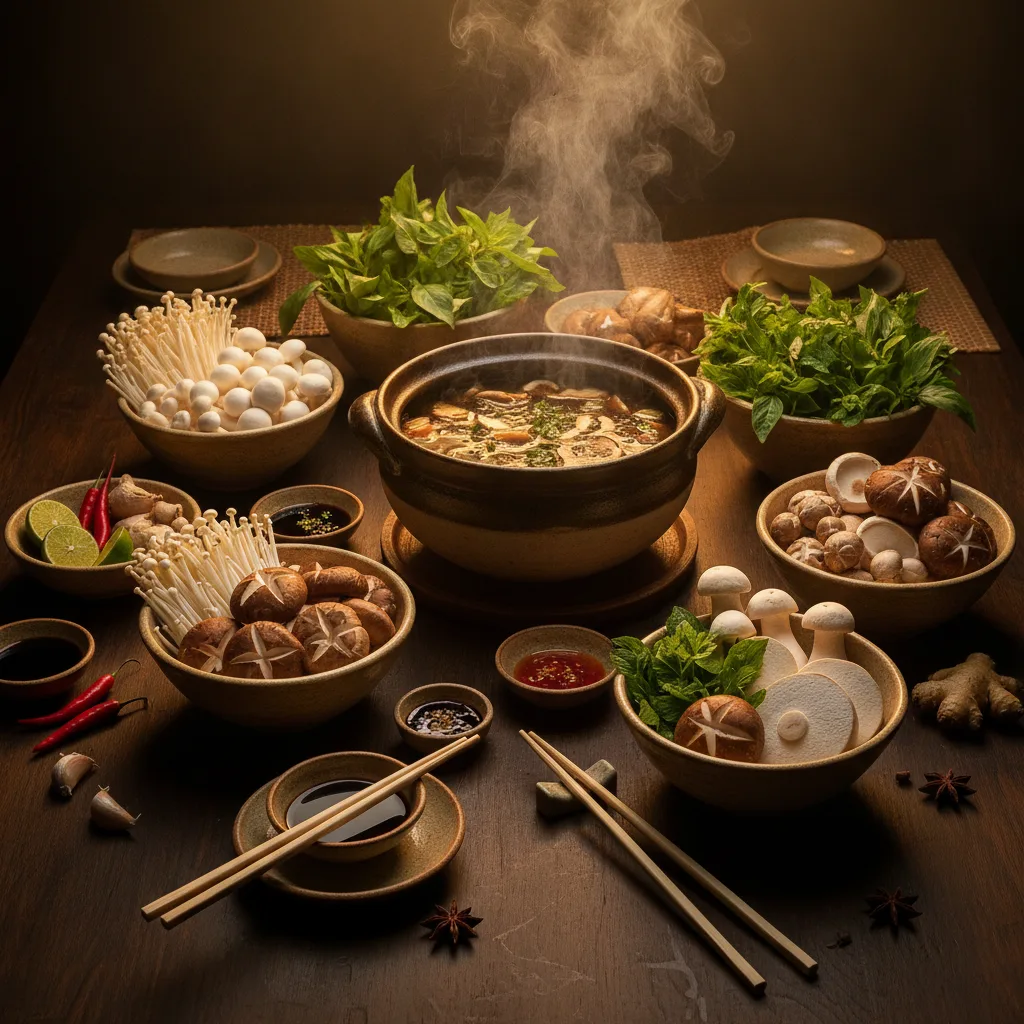
In Vietnamese plant-based cuisine and, more broadly, in Asian mushroom recipes, mushrooms never play a supporting role. They provide texture, depth of flavour and that umami sensation often associated with animal products. Shiitake, enoki, oyster mushrooms, wood ear mushrooms—each variety has its own texture, aromatic profile and uses.
Understanding Asian mushroom recipes means understanding how a broth becomes full-bodied, how a wok dish stays crunchy and how a meat-free dish truly satisfies. This 2026 guide provides useful pointers, from rehydration to cooking, as well as health precautions. At Mây Bay in Vincennes, these mushrooms are at the heart of a 100 % vegetarian and vegan menu.
Asian cuisine mushrooms, the complete guide 2026
Reading time: ~8 mins
- Which mushrooms are used in Vietnamese plant-based cuisine?
- Shiitake, enoki and oyster mushrooms: what are the differences?
- Fresh or dried Asian mushrooms: which should you choose?
- How to cook Asian mushrooms in a wok and in broth
- Can you eat shiitake mushrooms raw?
- Umami, nutrition and plant-based cuisine
- Mushrooms in our cuisine, in Vincennes
- Taking things further with Asian mushroom recipes
- Frequently asked questions about mushrooms in Asian cuisine
Which mushrooms are used in Vietnamese plant-based cuisine?
Vietnamese cuisine without meat or fish relies on a small group of varieties found throughout Asia. Shiitake, Lentinula edodes, dominates broths and stuffings thanks to its woody flavour and dense flesh. Black fungus, also known as wood ear, Auricularia auricula-judae, is indispensable in dumplings, spring rolls and soups for its elastic, crunchy texture.
Oyster mushroom, Pleurotus ostreatus, provides a supple bite that absorbs sauces perfectly. Enoki, Flammulina velutipes, fine and thread-like, is added to broths at the end of cooking. Shimeji, firm and slightly crunchy, is also encountered, as are king oyster mushroom or eringi, with its thick stem, maitake, Grifola frondosa, with a frond-like texture, and straw mushroom, widely used in curries and slow-cooked dishes in Southeast Asia.
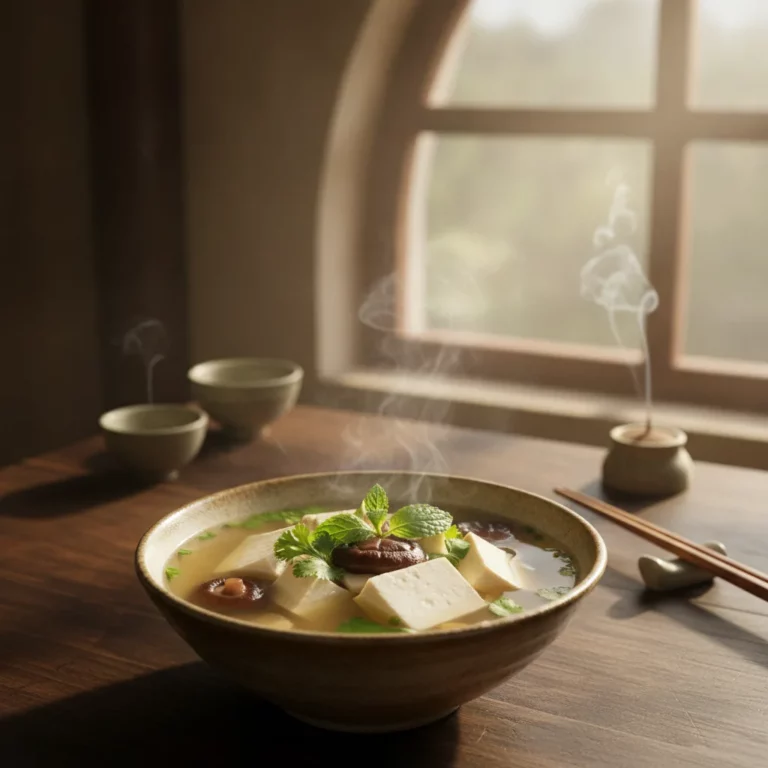
This diversity explains why Asian mushrooms and their varieties occupy such a central place in plant-based cuisine. Where a traditional recipe would seek texture from an animal protein, vegetarian Vietnamese cuisine creates it by combining mushrooms, tofu, rice vermicelli and aromatics. In our Mây Bay Delight, a homemade satay soup with vegetable stock, rice noodles, tofu and shiitake, it is precisely this layering of textures that gives the dish its consistency.
Shiitake, enoki and oyster mushrooms: what are the differences?
The three most requested varieties are distinguished by their aromatic profile and how they behave during cooking. Shiitake has a distinct woody flavour and pronounced umami, particularly concentrated when dried. Enoki has a subtle taste and mainly contributes crunch, which means it must be added right at the end of cooking, as in shabu-shabu or hot pot.
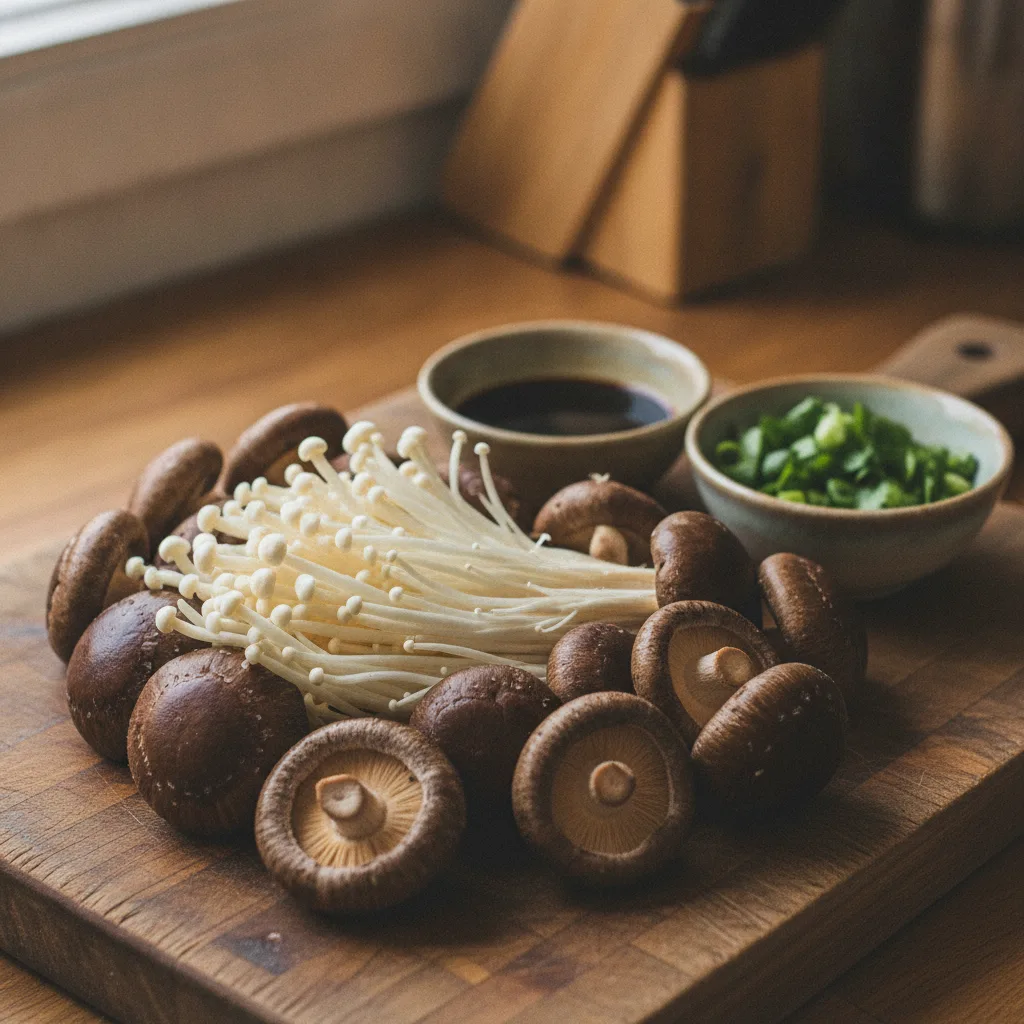
Oyster mushroom lies between the two, mild and slightly woody, with supple flesh that tears apart by hand to better hold sauces. The table below summarises the reference points used in cooking.
| Variety | Aromatic profile | Texture | Recommended uses | Common format |
|---|---|---|---|---|
| Shiitake | Woody, pronounced umami | Meaty | Broths, ramen, stir-fries, sauces, stuffings | Fresh or dried |
| Enoki | Mild, subtle | Fine and crunchy | Soups, hot pot, shabu-shabu | Fresh |
| Oyster mushroom | Mild, slightly woody | Supple and meaty | Wok dishes, stews, side dishes | Fresh |
| Shimeji | Woody, umami | Firm and crunchy | Stir-fries, rice, noodles | Fresh |
| King oyster mushroom | Pronounced, woody | Dense and firm | Grilled dishes, pan-fried dishes, plant-based dishes | Fresh |
| Wood ear mushroom | Mild | Springy and crunchy | Soups, dumplings, stir-fries | Dried |
| Maitake | Intense, woody | Fibrous and tender | Stir-fries, broths, rice | Fresh |
| Straw mushroom | Mild | Soft | Curries, soups, stir-fries | Canned |
Fresh or dried Asian mushrooms: which should you choose?
The question comes up time and again, both in home cooking and in the catering industry. Fresh mushrooms offer the best texture and a more appealing presentation, but have a short shelf life. Dried mushrooms, on the other hand, concentrate the flavours, keep for a long time and transform an ordinary broth into a deeply flavoured base. Black fungus, for example, is almost always found in dried form and regains all its crispness after rehydration. Canned products, such as straw mushrooms, ensure regular availability but have a less firm texture, making them more suitable for curries and dishes prepared in large quantities.
Rehydration is a technical step in its own right. Dried shiitakes require around 30 minutes to 1 hour of soaking, depending on their thickness, in clean, cold or lukewarm water. They should then be drained, the overly tough stems removed, and the soaking water carefully filtered. This water is never waste; it serves as the basis for a stock, sauce or braise. Once rehydrated, mushrooms behave like fresh produce and must be kept chilled and used quickly.
Good to know
The soaking water from dried shiitakes concentrates much of the mushroom’s umami. Filter it to remove particles of soil, then add it to your stock rather than throwing it away.
How to cook Asian mushrooms in a wok and in broth
Wok cooking
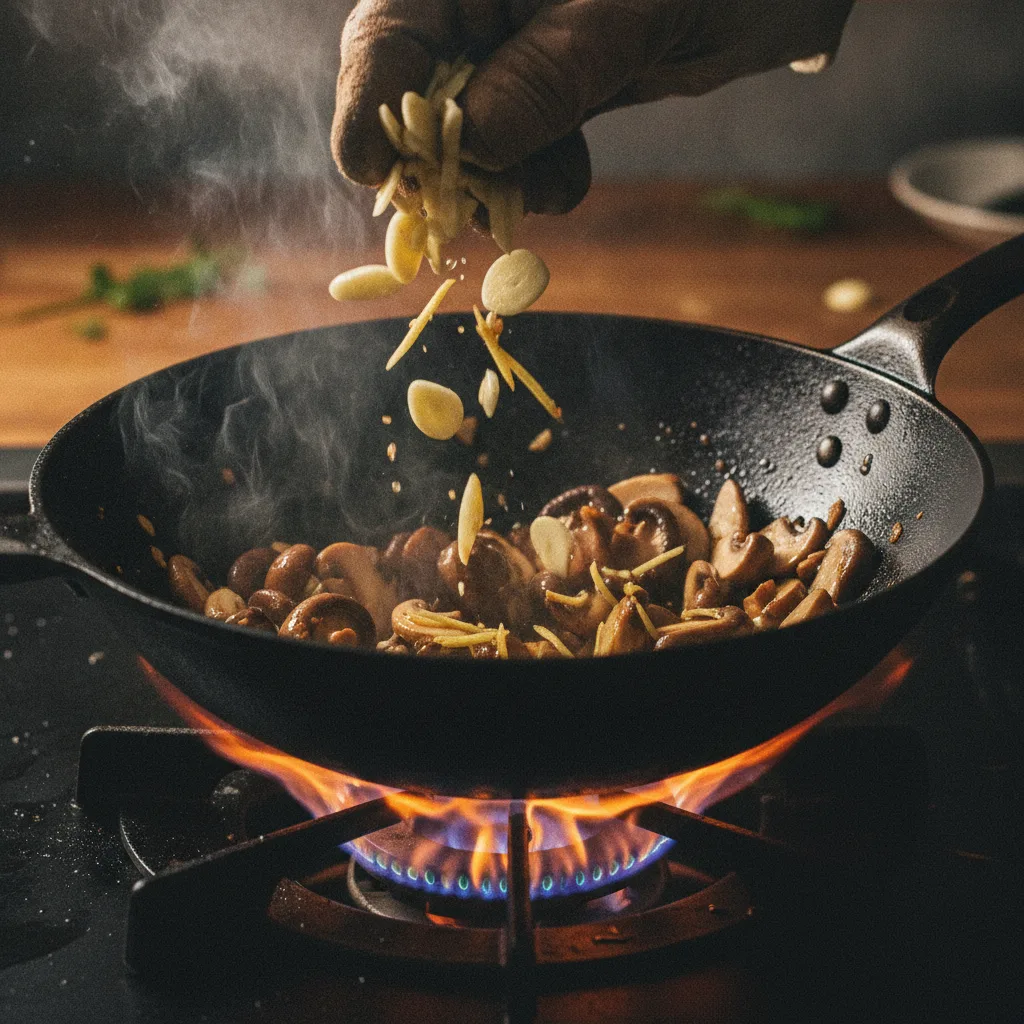
Quick searing remains the best method for wok mushrooms. The principle is simple: heat the vessel thoroughly, add a small amount of oil, then sear the mushrooms in small batches. Overloading the wok causes the temperature to drop, so the mushrooms release their water and boil instead of browning. Asian aromatics—ginger, garlic, lemongrass—and soy sauce are added afterwards, just before serving. Shiitake, shimeji, oyster mushrooms and king oyster mushrooms all work well with this quick searing method; in Vietnamese cuisine, oyster mushrooms are often torn by hand to create irregular pieces.
Mushrooms in soups and stocks
For Asian mushrooms in soups and stocks, the approach is reversed. The aim is a slow diffusion of flavours, with rehydrated shiitakes or wood ear mushrooms infusing the liquid, then enoki mushrooms added at the last moment to retain their crunch. This is the approach found in vegetarian pho, miso soup, vegetarian dashi with dried mushrooms or in our Hu Tieu Mây Bay. For cleaning, a damp cloth or soft brush is sufficient for fresh mushrooms, as prolonged washing saturates the flesh with water and prevents good browning.
Can you eat shiitake mushrooms raw?
No, and this is a food-safety point that is too often overlooked. ANSES has documented cases of flagellate dermatitis occurring after the consumption of raw or insufficiently cooked shiitakes. In practice, a shiitake should always be cooked through, never served simply marinated or raw in a salad. Enoki mushrooms, often eaten lightly cooked, also require particular care with regard to hygiene, and thorough cooking remains preferable for vulnerable people.
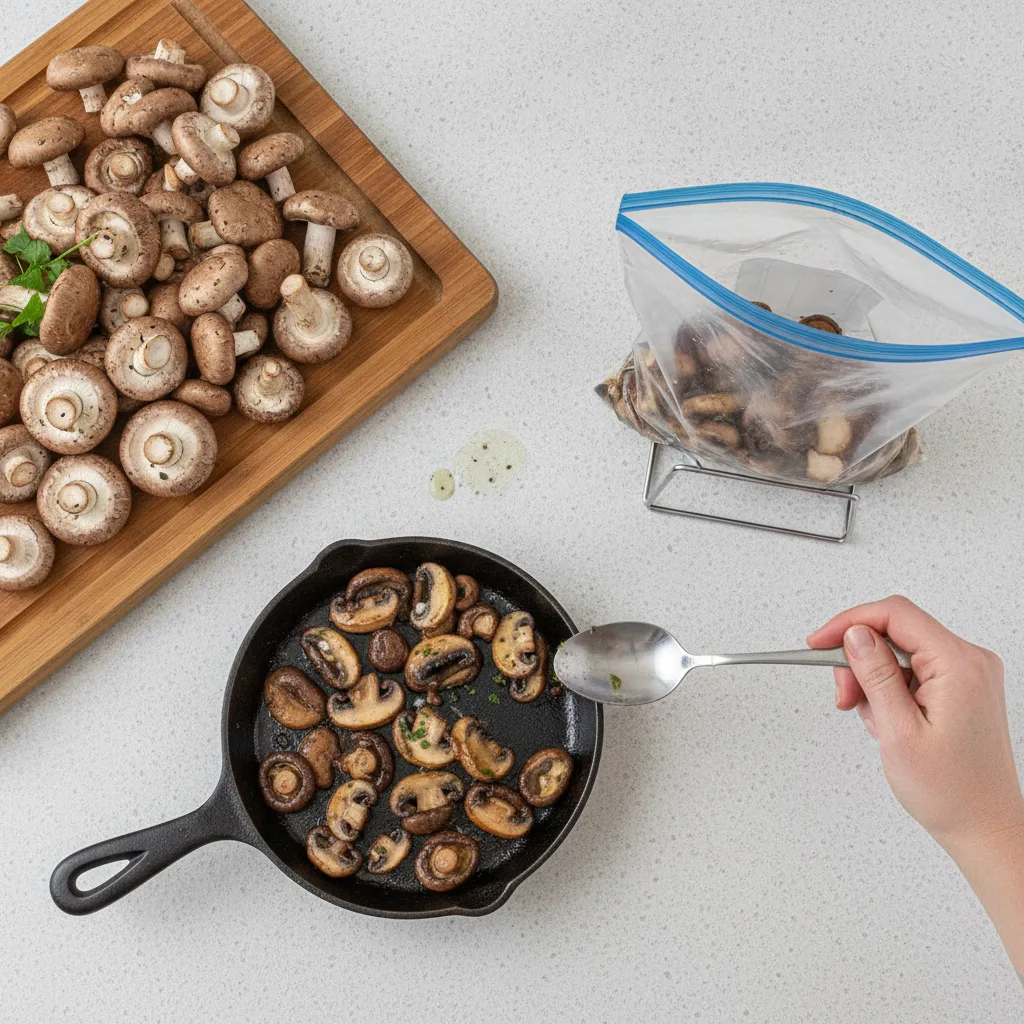
In catering, this requirement forms part of the establishment’s HACCP procedures, with checks on receipt, separation of soiled products from clean products, and strict adherence to temperatures and storage times. Fresh mushrooms should be kept in the refrigerator in packaging that allows a little air to circulate and limits condensation. Dried mushrooms should be stored in a dry place, away from light and moisture. For Asian mushrooms in catering, portion cost calculations must also factor in the yield after cooking and, for dried products, the weight gain after rehydration as well as losses from sorting.
Important
Raw or undercooked shiitake can cause flagellate dermatitis, according to Anses toxicovigilance research. Thorough cooking is not optional; it is a rule.
Umami, nutrition and plant-based cuisine
Mushrooms are composed mostly of water and remain low in energy and fat. They provide dietary fibre, moderate amounts of plant-based protein, B-group vitamins such as riboflavin, niacin and folates, as well as several minerals including potassium, phosphorus, copper, zinc and magnesium. These data from the scientific literature on mushroom composition explain their natural place in a balanced vegetarian or vegan diet, without any need to attribute therapeutic properties to them.
Their true culinary strength lies elsewhere. Umami mushrooms in plant-based cuisine replace the depth of flavour usually provided by meat-based stocks, while offering a meaty texture that gives the dish substance. A successful vegan dish is not defined by what it removes, but by what it creates, and mushrooms are one of the pillars of that creation. They are, of course, compatible with a vegan diet, provided you check the composition of sauces and accompaniments, as some commercial seasonings contain animal extracts.
Mushrooms in our cuisine, in Vincennes
At Mây Bay, our concept is based on combining a venue serving fresh, healthy dishes with a contemporary setting for relaxation. Mushrooms feature from the beginning to the end of the meal, in the Ha Cao vegetable ravioli, , in the Cha Gio, our crispy spring rolls, in the broths and in the stir-fried dishes.
We work with fresh and dried varieties according to the preparation, reserving dried mushrooms for long-cooked bases and fresh mushrooms for quick cooking. You can discover these dishes on our card, and order them to take away or book your table.
Taking things further with Asian mushroom recipes
Mastering Asian cooking mushrooms means having a complete palette of textures and aromas for plant-based cooking that stands perfectly well on its own. Shiitake for depth, wood ear mushrooms for crunch, oyster mushrooms for bite, enoki for delicacy—each has its role and its cooking time.
Remember the three essential rules:
- Rehydrate properly and keep the soaking water.
- Sear over high heat and in small quantities.
- Cook shiitake mushrooms through.
The rest is a matter of balancing the aromatics, stock and texture.
FAQ: Asian cooking mushrooms
Can fresh Asian mushrooms be frozen?
Yes, but the texture is often altered, as freezing causes the water-filled cells to burst. Frozen mushrooms work well in stir-fries and cooked dishes, less so as garnishes where appearance matters. Briefly pre-cooking them before freezing limits the loss of firmness.
What can be used instead of wood ear mushrooms if they are unavailable?
No variety exactly replicates its springy crunch. Shimeji or finely sliced oyster mushrooms come close in a stir-fry, but for a ravioli or filling, it is better to keep a stock of dried mushrooms, whose long shelf life precisely avoids this kind of supply shortage.
Are Asian mushrooms grown in France?
Shiitake, oyster mushrooms and king oyster mushrooms are now produced by French mushroom farms, allowing fresh supplies through short supply chains. Wood ear mushrooms and straw mushrooms are still mostly imported in dried or tinned form.
Are mushrooms digestible for everyone?
They contain fibre and sometimes tough cell walls, which can be troublesome for people with sensitive digestion. Sufficient cooking and fine slicing significantly improve digestibility, and it is preferable to avoid large portions in the event of known discomfort.
Should mushrooms be salted at the beginning or end of cooking?
At the end of cooking, because salt draws water out of the flesh and prevents browning. In a wok, salt or soy sauce is added once the mushrooms are already browned, preserving both the texture and the aromatic profile.