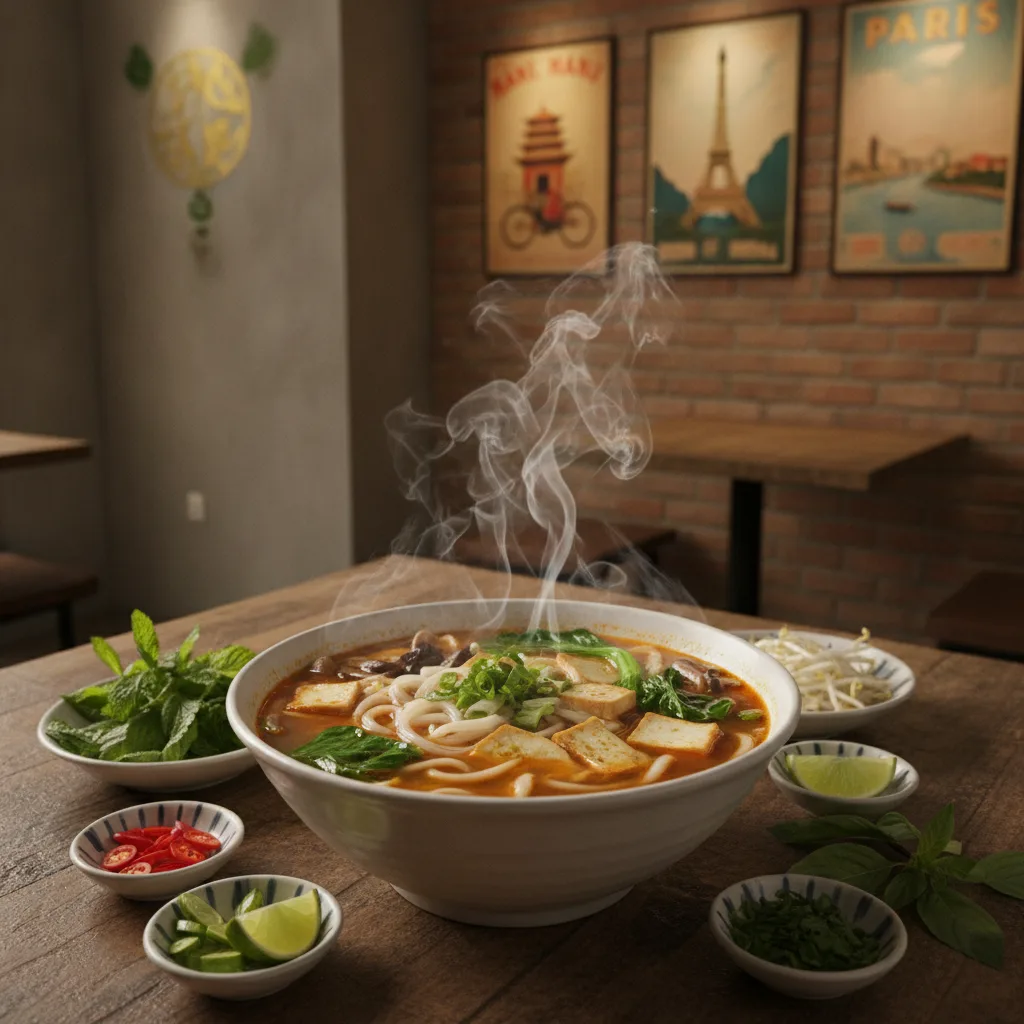
Phở is much more than just a soup. It is a story in its own right – the story of a dish born at the crossroads of two cultures, shaped by colonial history, migration and popular creativity. Now Vietnam’s national dish, it has spread across the globe via the diaspora, eventually finding its way onto plates in Paris. At Mây Bay, in Vincennes, we wanted to pay tribute to the history of phở whilst reinterpreting it through a 100% plant-based cuisine, without betraying the spirit of the original dish.
To gain a better understanding of the history of pho and how this dish travelled before inspiring our plant-based cuisine, let’s take a look back at its journey from northern Vietnam to the dining tables of today.
The Secret History of Pho: from the origins of pho and street-side broth to refined vegan soup
Reading time: ~7 mins
A surprisingly recent dish
A modern take on a classic dish
One might think that phở dates back centuries, like so many other Asian dishes. This is not the case. Historians and experts in Vietnamese cuisine agree that it first appeared at the very beginning of the 20th century, making it a relatively young dish compared with Vietnam’s 3,500-year history.
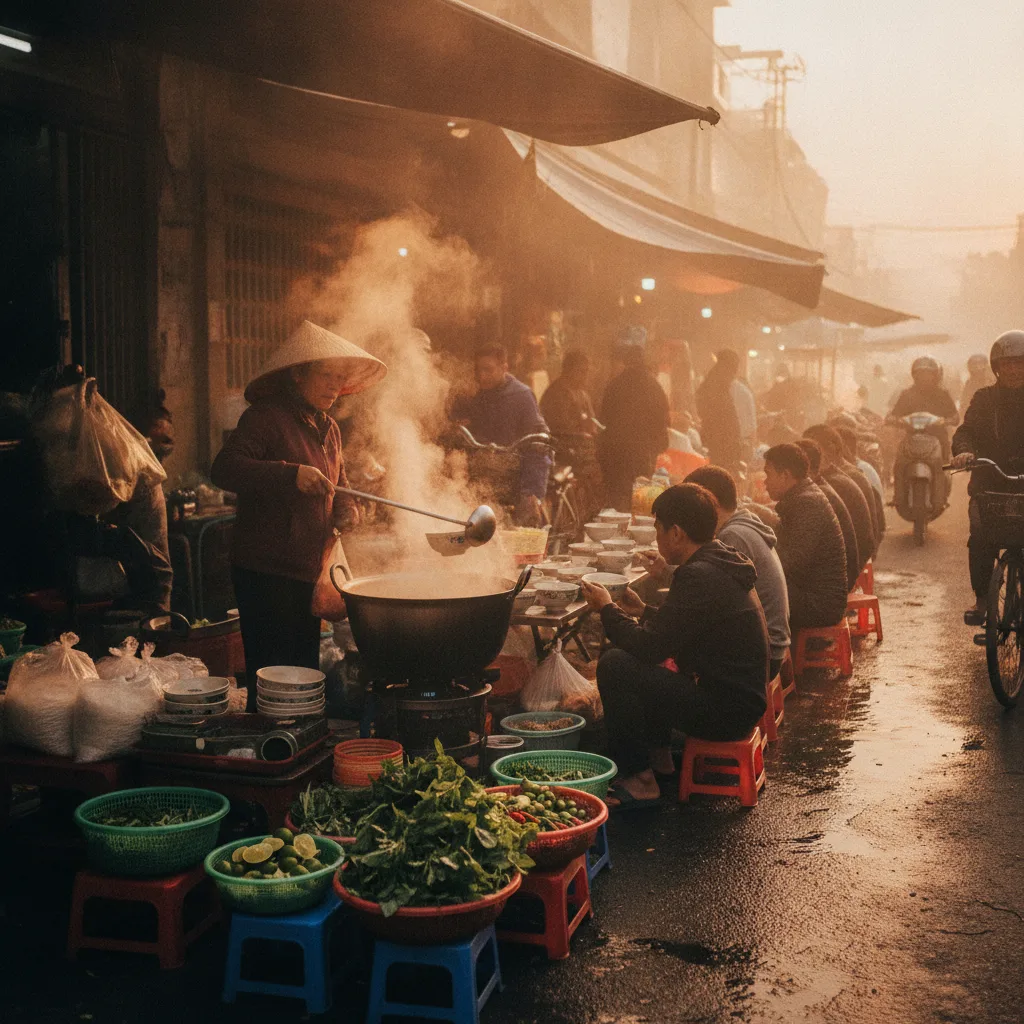
This late emergence can be largely attributed to the colonial context. Under French rule, the consumption of beef grew in northern Vietnam, particularly through the establishment of abattoirs to feed the colonists and soldiers. Beef, which until then had been rarely found in the Vietnamese diet, gradually became more widely available. It was against this backdrop of cultural fusion and new food sources that Tonkinese soup first emerged.
The first written reference to phở dates back to this same colonial period, which confirms that it is rooted in modernity rather than in a thousand-year-old tradition. Paradoxically, it is this relative youth that has enabled it to evolve, adapt and, ultimately, cross borders.
Nam Định, the birthplace of a culinary legend
Most historical accounts trace the geographical origins of phở to the province of Nam Định, in northern Vietnam. At the time, this region was a major industrial centre, particularly in the textile sector, and was home to a mix of Vietnamese and foreign workers. It was in this multicultural environment that, according to legend, a local chef is said to have devised a recipe capable of satisfying both Vietnamese palates and French tastes.
From Nam Định, the soup made its way to Hanoi, where it gradually established itself as an integral part of everyday life. By the 1930s and 1940s, phở was already being eaten at all hours in the northern capital, including for breakfast – a custom that would endure. It gradually became a mainstay of Vietnamese street food, sold in the alleyways by street vendors carrying their pots over their shoulders.
The three theories on the origin of the name
The etymology of the word «phở» is one of the most hotly debated topics amongst historians and lovers of Vietnamese cuisine. There are three main theories, and none of them is universally accepted.
The first, and undoubtedly the most widespread, is the «French pot-au-feu» theory. The Vietnamese pronunciation of «phở» is phonetically very similar to the French word ‘feu’. According to this theory, Vietnamese cooks adapted the pot-au-feu requested by the colonists, replacing European herbs with local spices and adding rice noodles. This version is appealing for its historical coherence and its symbolic aspect – that of a dish born of the forced encounter between two civilisations.
The second theory suggests an older soup, xáo trâu, made with buffalo meat and popular in northern Vietnam in the early 20th century. Beef is thought to have gradually replaced buffalo, and the recipe is believed to have been refined to give rise to phở as we know it today.
The third theory is linguistic in nature. Some historians trace the term back to Chinese words for rice noodles, linking it to Sino-Vietnamese trade, which has had a profound influence on the culinary culture of the north of the country. This hypothesis serves as a reminder that Vietnamese cuisine is, by its very nature, a fusion of culinary traditions.
A comparison of the main theories on nouns
| Theory | Suggested origin | Key points |
|---|---|---|
| French pot-au-feu | A Vietnamese adaptation of the pot-au-feu originally prepared for the settlers | The phonetic similarity between «phở» and «feu», the arrival of beef via colonial slaughterhouses, and the addition of local spices and rice noodles |
| Buffalo soup (xáo trâu) | The evolution of a popular buffalo soup in northern Vietnam | The gradual replacement of buffalo with beef, and the refinement of the recipe to create modern phở |
| Chinese linguistic influence | Chinese terms for rice noodles | Ancient Sino-Vietnamese exchanges: a reminder of Vietnamese cuisine, shaped by cultural cross-fertilisation |
Its exact origins remain unclear. The available sources are often from later periods and are sometimes contradictory. But this air of mystery adds to the dish’s charm.
From north to south, then out into the world
From northern phở to southern phở
Following the partition of Vietnam in 1954, phở followed the flow of people migrating from the north to the south. Upon arriving in Saigon and the southern provinces, it underwent a transformation. Northern phở is light, subtle and sparsely garnished. Southern phở becomes richer and more aromatic, served with a profusion of fresh herbs, bean sprouts, Thai basil leaves and slices of lime. Two styles, one soul.
An iconic dish of the Vietnamese diaspora
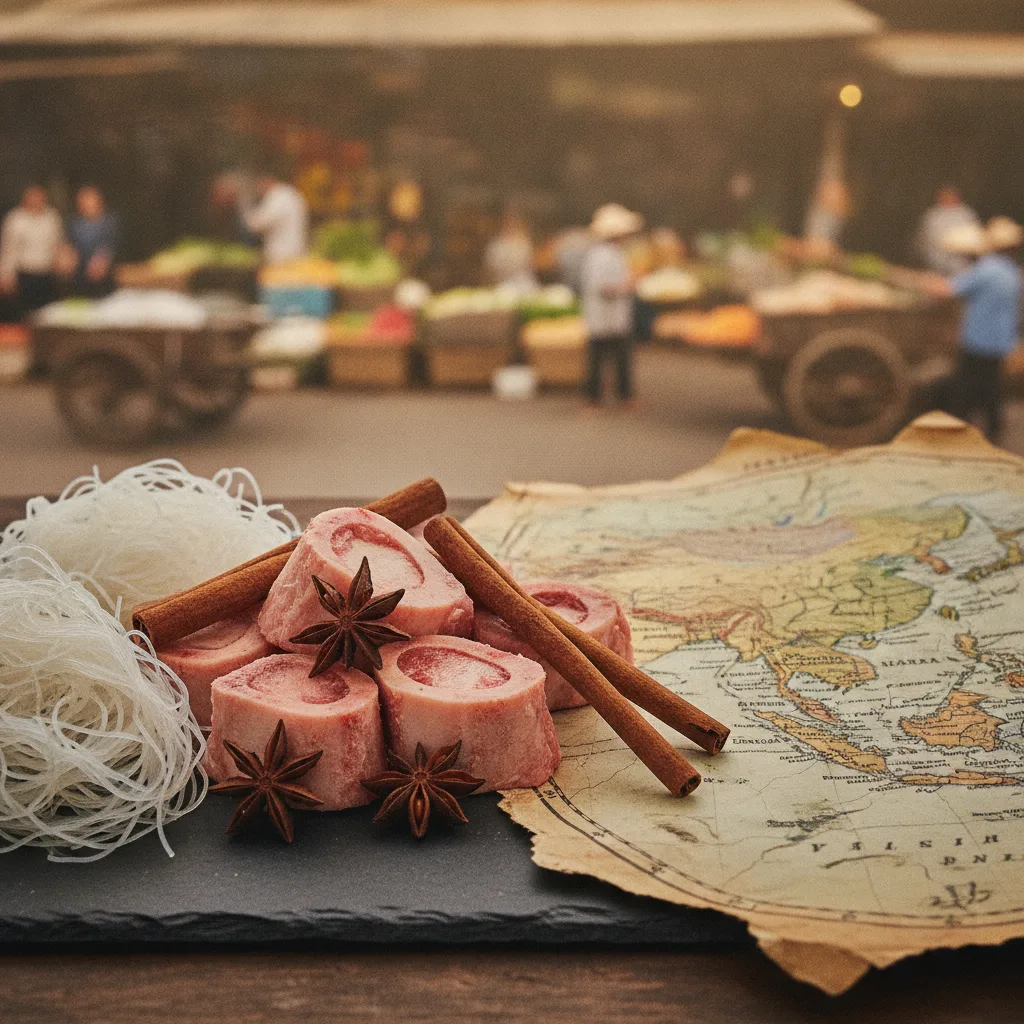
Then came 1975. The exodus of hundreds of thousands of Vietnamese to Europe, North America and Australia took with it recipes, expertise and cooking pots. Paris, Montreal, Los Angeles and Sydney saw the opening of the diaspora’s first phở restaurants. In France, Paris’s 13th arrondissement became a hub, with restaurants carrying on the tradition of the slow-simmered broth.
Today, Vietnamese soup is recognised worldwide as one of the most iconic dishes in Asian cuisine.
What makes a genuine phở
The balance between broth, noodles and toppings
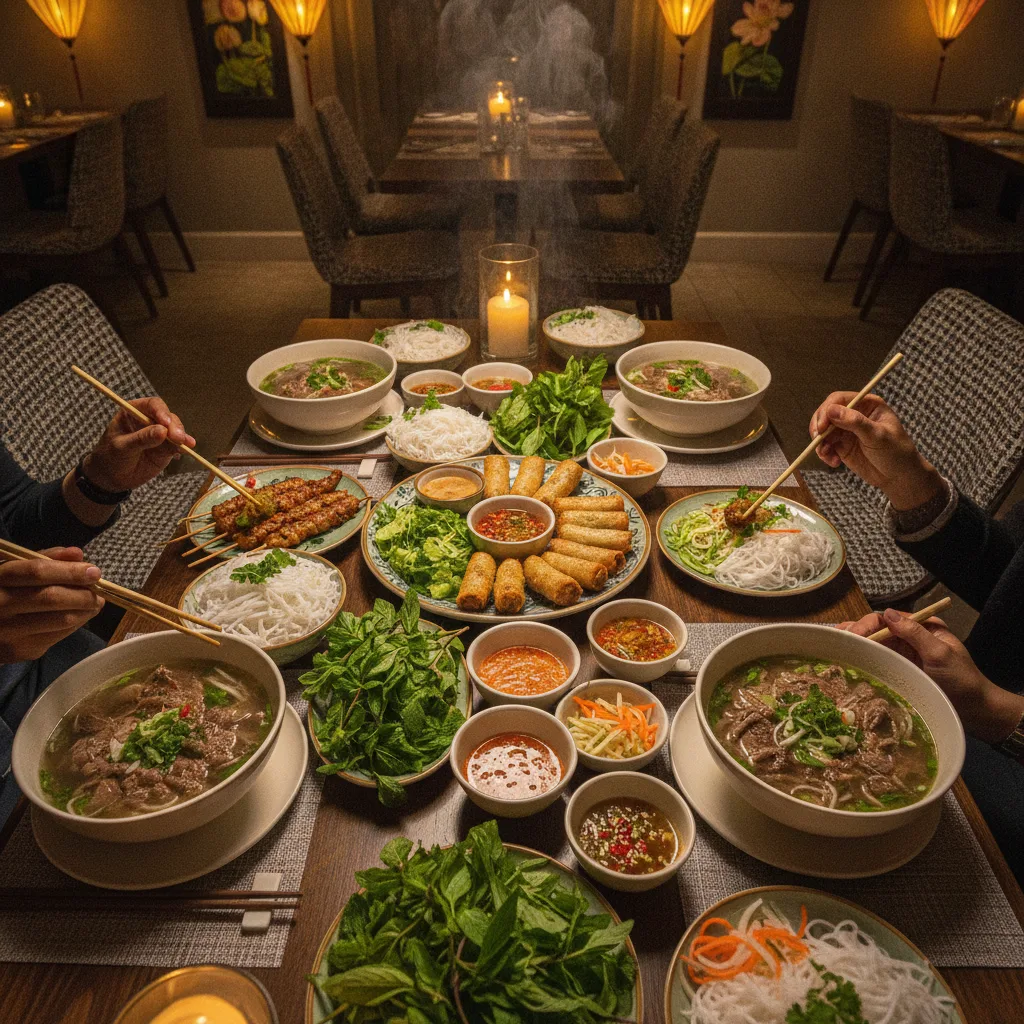
A bowl of phở relies on a delicate balance between several elements. The stock is the centrepiece. Simmered gently for several hours, it derives its depth of flavour from roasted spices – star anise, cinnamon, ginger, tsaoko cardamom, as well as flame-roasted onions. It is this roasting technique that gives the broth its amber colour and complex flavours.
Flat rice noodles are cooked separately and then arranged in the bowl with the toppings. The herbs – coriander, chives and basil – are added at the last minute to preserve their freshness. Lime, chilli and sauces allow each diner to adjust the flavours to their own taste.
It is this sensory composition – the warmth of the broth, the freshness of the herbs, the crunch of the garnishes – that makes phở an experience in its own right, far more than just a simple soup.
The plant-based version: a natural evolution
Adapting phở to a 100 % plant-based cuisine is not a betrayal. It is an evolution that is consistent with the very history of the dish. Phở has always adapted to different contexts, regions, constraints and tastes. At Mây Bay, the stock is made from a vegetable base that has been simmered for a long time, enriched with the same traditional spices – star anise, ginger and cinnamon – which give the dish its signature aroma. Tofu, shiitake mushrooms and fresh herbs replace the meat without compromising on richness or aromatic depth.
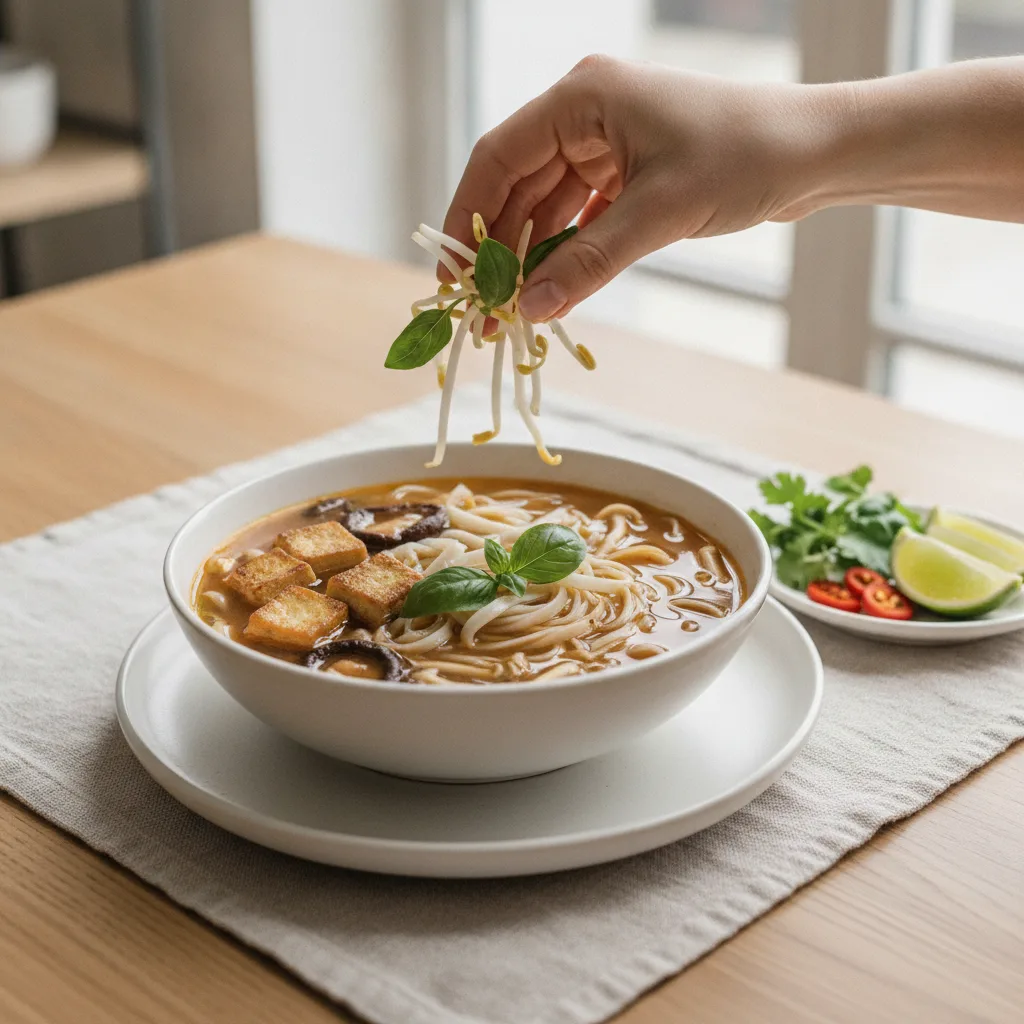
The result is a Homemade stir-fry soup, vegetable stock, rice noodles, tofu and shiitake mushrooms which stays true to the original spirit of phở whilst appealing to those seeking a more plant-based diet, without compromising on flavour. It is also an invitation to discover that Vietnamese cuisine is, by its very nature, centred on vegetables, herbs and lightness.
FAQ
Is phở really of French origin?
Not exactly. The most widely accepted theory suggests that phở developed under French influence, notably through the introduction of beef via colonial abattoirs and a possible adaptation of pot-au-feu. But its precise origins remain a matter of debate. Other theories point to a pre-existing buffalo soup or Chinese influences. What is certain is that phở is a Vietnamese creation, born out of a context of cultural exchange in the early 20th century.
What is the difference between northern and southern phở?
Northern phở, which originated in Hanoi and Nam Định, is characterised by a clear, unadorned broth with few garnishes. Southern-style phở, which developed from 1954 onwards as a result of internal migration, is more generously laden with fresh herbs, bean sprouts and condiments. Both styles now coexist in Vietnamese restaurants around the world, each with its own passionate supporters.
Can you make authentic phở without meat?
Yes, provided you put a lot of effort into the stock. The soul of phở lies in its roasted spices and the length of time it is simmered. A carefully prepared vegetable stock, flavoured with star anise, roasted ginger and cinnamon, can achieve remarkable aromatic depth. This is precisely the approach taken at Mây Bay, where every bowl demonstrates that plant-based cuisine can be just as rich and complex as the traditional version.
Where can you find vegan phở in Vincennes and in eastern Paris?
Mây Bay, located in Vincennes, is one of the few restaurants in eastern Paris to offer a menu consisting entirely of vegetarian and vegan Vietnamese cuisine. Every dish is prepared on the premises using fresh ingredients, in keeping with traditional Vietnamese culinary techniques.
Phở: a living cultural heritage, in a plant-based version
Phở alone embodies the genius of Vietnamese cuisine: its ability to transform simple ingredients into a complex sensory experience, to adapt without losing its identity, and to travel the world without losing its essence. Its history, blending colonial influences, migration and popular creativity, makes it much more than just a dish; it is a living heritage. At Mây Bay, we offer a plant-based interpretation true to this spirit, in a contemporary setting designed for relaxation and discovery. To explore our cuisine further, visit our menu and let yourself be guided by the flavours of Vietnam.